
Thursday, September 4
6 September 2025
Thursday, September 4
6 September 2025
Friday, September 5, 2025
h. 6.30 - 9 pm
Program
h. 6.30 pm | Grumello Greenhouse
Fabula Rara
Concept and dramaturgy by Alberto Pederneschi
Dance and choreography by and with Francesca Cervellino
With Alberto Pederneschi on drums, percussion, and music
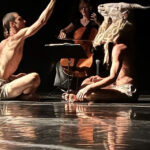
Fabula Rara is a seductive dialogue between Music and Movement. Dreamlike landscapes and harsh reality, archaic hints and experimentation are the elements that bring this contemporary fable to life. The performance, structured in imaginary scenes, tells of the multiple metamorphoses of the human being striving to constantly surpass their own limits. Bold improvisations, choreography, and musical composition intertwine to create an engaging narrative journey and a kaleidoscope of moods, emotional flows, and suggestions.
Francesca Cervellino is a dancer/performer, choreographer, and martial artist. She began studying dance and theater at a young age—a passion that led her to further her training both in Italy and abroad with internationally renowned teachers and companies. She trained in contemporary dance, dance-theater, and Contact Improvisation in Italy and internationally, attending, among others, the “Laborgras” studio in Berlin and “Dance New Amsterdam” in New York. In 2011, she was selected to study in London with the DV8 Physical Theatre group. She is also a teacher of dance, Qi Gong, and Chinese internal martial arts. As a dancer and performer/actress, she collaborates with several theater companies in Lombardy and with various Italian contemporary dance groups. In 2018, she co-founded Collettivo Kun, a contemporary dance and performing arts research group that creates performances and multidisciplinary artistic projects. Her works have been presented at venues such as Teatro San Teodoro (Cantù), Teatro Sociale di Como, Teatro Lauro Rossi (Macerata Opera Festival), Romaeuropa Festival, Can Batllò (Barcelona), Festival JAZZMi, and Festival Ticinoindanza.
Alberto Pederneschi is a drummer and percussionist, born in Milan in 1971. Fascinated by unconventional approaches to his instrument, he created Microcosmo, a solo project for prepared drum set. In 2021, he released a CD of the same name on the UK-based label FMR Records. He is also co-creator of Prima Luz, a duo project with pianist Antonio Vivenzio. He currently performs with: Val Bonetti & The Hot Jazz Machinery, Osmosi Trio, Camilla Barbarito & Sentimento Popolare, and Red Sails. Over the years, he has collaborated with artists including Lucia Bosè, Giovanni Nuti, Roberto Dani, Patricia Zanco, Yuri Goloubev, Marco Brioschi, Aronne Dell’Oro, Paola Tintinelli, Alberto N.A. Turra, Carlo Nicita, Gabriele Orsi, Yuriko Mikami, Fakhraddin Gafarov, Luca Dell’Anna, Raffaele Kohler, Simone Mauri, Nema Problema Orkestar, Alfredo Ferrario, Max Ferri, Claudio Sanfilippo, Simone Massaron, and Simone Maggio. He has performed at numerous festivals and events, including: RAI Radio 3 Piazza Verdi, JazzMI, Carroponte, Jazz in Sarpi, Tremezzina Music Festival, Cala Gonone Jazz Festival, Lugano LongLake Festival, Bià Jazz Festival, La Mar de Músicas (Cartagena, Spain), Break in Jazz, SummerNite Jazz, Amfiteatrof Festival, Sonata Islands Festival, San Benedetto Acoustic Guitar Festival, Premio Bindi, and the Montescudaio Theater Festival.
h. 7.30 pm | Cedar of the Villa
CHEZA
A project by and with Ernesto Aleixo
Directorial and choreographic supervision by Roberto Castello
With live music by Marco Martinelli
Produced by ALDES
With the support of MIC / Directorate-General for Performing Arts, and REGIONE TOSCANA / Regional Performing Arts System
In Swahili—the national language of Tanzania and many East African countries, and the most widely spoken Bantu language—cheza means to dance, to play music, to play, or to gamble. Depending on the context, it can take on countless other shades of meaning. In southern Mozambique, where Ernesto Aleixo lives, cheza is often used during traditional dances as a way of urging one another on, to keep the rhythm and energy from dropping. Cheza is elegance, play, sensuality, and attunement to the present moment—but it can also be a cry for help or a command.
The performance walks a fine line between Makonde tradition (the people to whom Ernesto Aleixo belongs) and contemporary expression, drawing inspiration from the approach of the most conscious and courageous jazz musicians of the decolonization and Black Power era—beginning with Ornette Coleman. It’s an approach where the body becomes the instrument of a completely free and instinctive flow of improvisation, blending without prejudice modernity and a past—sometimes ancestral—lived and forgotten, yet still residing in the body beyond the awareness of its bearer. There is no room for nostalgia here—only the desire not to sever the roots of a past that existed and that must remain a source from which to draw, in order not to lose the rhythm of life and one’s identity. Cheza, with its polysemic nature, the essential musical accompaniment by Marco Martinelli, and the impassioned gestural stream of consciousness by Ernesto Aleixo, becomes a fundamentally political text—rich, powerfully surprising, and utterly irreducible to the structures of verbal language.
Ernesto Aleixo is a Mozambican dancer and percussionist, coordinator of a traditional Makonde dance and song group in the province of Cabo Delgado. He collaborates with both Mozambican and international choreographers and is a performer in Karingana Wa Karingana, directed by Roberto Castello, part of the Tempi Moderni Mozambico project supported by the Italian Ministry of Culture under the Boarding Pass Plus program. In 2025, he was awarded a scholarship to participate in the Borgo Live Academy, curated by Artisti Associati in Gorizia, where he also led masterclasses in traditional Cabo Delgado dance (Limbondo). His latest solo work, Cheza, will premiere at the 2025 edition of the Visavì Festival.
Roberto Castello is a dancer, choreographer and teacher, considered one of the pioneers of contemporary dance in Italy. In the early 1980s, he performed in Venice with “Teatro e Danza La Fenice” directed by Carolyn Carlson, where he also created his first choreographic works. In 1984, he was among the founders of Sosta Palmizi. In 1993, he founded ALDES, through which he has carried out extensive experimentation across dance, visual arts, and new technologies, producing numerous stage and non-stage works. Since 1996, he has curated various festivals and series. From 2005 to 2015, he taught digital choreography at the Brera Academy of Fine Arts in Milan. Since 2008, with ALDES, he has led the project SPAM! – network for contemporary arts in the province of Lucca, hosting artist residencies and a multidisciplinary program of performances, workshops, educational activities, and public events. In 2017, he launched the blog 93% – materials for a non-verbal politics, a platform for reflection, exchange and dialogue on non-verbal language. In 2021, Altreconomia published Trattato di economia – Riflessioni semiserie sulla dimensione economica dell’esistenza, co-written with Andrea Cosentino. That same year, he contributed to the volume Nel migliore dei mondi possibili. Intorno all'opera di Roberto Castello, edited by Valentina Valentini with Chiara Pirri and Valeria Vannucci (Ephemeria Edizioni). Throughout his career, he has collaborated with artists and institutions such as Peter Greenaway, Eugène Durif, RAI3 / Fabio Fazio and Roberto Saviano, and Studio Azzurro. He has consistently advocated for the recognition of contemporary dance and for a fair, efficient, and sustainable performing arts system.
He has received four UBU Awards (1985, 2003, 2018, 2022).
ALDES is a collective of artists and cultural professionals which, since 1993 under the artistic direction of Roberto Castello, has been producing and promoting choreographic works with a strong focus on the intersections between dance and visual arts, new technologies and theatre. Its productions span performances, videos, installations, and multidisciplinary events that revolve around the body, movement, and their representations. ALDES is a model of responsible cultural management, committed to artistic freedom and to reducing the bureaucratic burden on artists. Since 2008, in the province of Lucca, ALDES has run the SPAM! – network for contemporary arts, hosting residencies and a multidisciplinary calendar of shows, workshops, education and outreach. In 2017, the group launched the blog 93% – materials for a non-verbal politics. In 2018, ALDES received the Special UBU Award for the “ALDES project”, “for its ongoing choreographic research combined with audience development strategies, for having fostered a new generation of contemporary dance artists, and for establishing a nationally recognized model with a distinctive yet non-monolithic artistic identity.” ALDES is supported by the Italian Ministry of Culture (MIC), Regione Toscana / Regional Performing Arts System and since 2013 has been a recognized Artistic Residency under Tuscany’s regional cultural law. Additional support comes from the Municipality of Capannori and the Fondazione Cassa di Risparmio di Lucca.
h. 8.30 pm | Cedar of the Villa
Dove cresce ciò che salva | Archivio sentimentale del movimento
Performance by and with Francesca Foscarini
Produced by Associazione Culturale Zebra
With the support of Associazione Culturale VAN, Fuorimargine – Dance Production Centre in Sardinia, and IntercettAzioni – Centro di Residenza Artistica della Lombardia / Circuito CLAPS
“In life, it is our salvation; not just our life, but the life of all living things,” Ginevra Bompiani, paraphrasing a verse by Hölderlin. These words become the title, the guide and the warning behind Francesca Foscarini’s latest artistic research. A journey that, by necessity and desire, unfolds entirely outdoors and in the open, precisely where what saves can grow. Here, stones – the bones of the earth, the skeleton of the world, our own skeleton – become the archive of the forces that compose and decompose life. It is upon this enigmatic presence (absence) that the artist’s journey is mapped out, in the difficult, never reassuring attempt to recover a lost biological memory: in that place where, perhaps, having abandoned the defense of rationality, having let go of time, it becomes possible to draw closer once again to the inconceivable universe and to ourselves, all of us who are alive, dreaming.
Francesca Foscarini is a choreographer, dancer and educator active in the national and international contemporary dance scene. Since 2009, her choreographic research has explored the body as an expressive space and a generator of new somatic and poetic languages. Her works have been presented at festivals such as Aerowaves, Biennale Danza Venezia, and MasDanza, and she has received several awards, including the Danza&Danza Prize 2018 as Emerging Choreographer. As a performer, she has collaborated with artists such as Yasmeen Godder, Alessandro Sciarroni, Marco D’Agostin, Roberto Castello, and Andrea Costanzo Martini. She is co-founder of the VAN Association, creator of the project Cactus | Progetti Spinosi and contributes to the dance programming of Terreni Creativi Festival. Alongside her creative work, she is deeply engaged in teaching and mentoring, participating in initiatives such as Incubatore/CIMD.
ALL INCLUSIVE TICKET PER DAY
Full price €10 per person
Reduced price (people with disabilities and children under 12) €5
Reservation required
In case of rain, an alternative indoor venue will be announced.
Performances scheduled at the Serra will be cancelled.
Some performances have limited capacity.

